• 1642 : Blaise Pascal, a French mathematician and philosopher, invents the first mechanical digital calculator using gears, called the Pascaline. Although this machine could perform addition and subtraction on whole numbers, it was too expensive and only Pascal himself could repare it.
• 1804 : Joseph Marie Jacquard used punch cards to automate a weaving loom.
• 1812 : Charles P. Babbage, the "father of the computer", discovered that many long calculations involved many similar, repeated operations. Therefore, he designed a machine, the difference engine which would be steam-powered, fully automatic and commanded by a fixed instruction program. In 1833, Babbage quit working on this machine to concentrate on the analytical engine.
• 1840s: Augusta Ada. "The first programmer" suggested that a binary system shouled be used for staorage rather than a decimal system.
• 1850s : George Boole developed Boolean logic which would later be used in the design of computer circuitry.
• 1890: Dr. Herman Hollerith introduced the first electromechanical, punched-card data-processing machine which was used to compile information for the 1890 U.S. census. Hollerith's tabulator became so successful that he started his own business to market it. His company would eventually become International Business Machines (IBM).
• 1906 : The vacuum tube is invented by American physicist Lee De Forest.
• 1939 : Dr. John V. Atanasoff and his assistant Clifford Berry build the first electronic digital computer. Their machine, the Atanasoff-Berry-Computer (ABC) provided the foundation for the advances in electronic digital computers.
• 1941 : Konrad Zuse (recently deceased in January of 1996), from Germany, introduced the first programmable computer designed to solve complex engineering equations. This machine, called the Z3, was also the first to work on the binary system instead of the decimal system.
• 1943 : British mathematician Alan Turing developped a hypothetical device, the Turing machine which would be designed to perform logical operation and could read and write. It would presage programmable computers. He also used vacuum technology to build British Colossus, a machine used to counteract the German code scrambling device, Enigma.
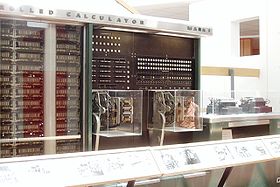
• 1944 : Howard Aiken, in collaboration with engineers from IBM, constructed a large automatic digital sequence-controlled computer called the Harvard Mark I. This computer could handle all four arithmetic opreations, and had special built-in programs for logarithms and trigonometric functions.
• 1945 : Dr. John von Neumann presented a paper outlining the stored-program concept.
• 1947 : The giant ENIAC (Electrical Numerical Integrator and Calculator) machine was developped by John W. Mauchly and J. Presper Eckert, Jr. at the University of Pennsylvania. It used 18, 000 vacuums, punch-card input, weighed thirty tons and occupied a thirty-by-fifty-foot space. It wasn't programmable but was productive from 1946 to 1955 and was used to compute artillery firing tables. That same year, the transistor was invented by William Shockley, John Bardeen and Walter Brattain of Bell Labs. It would rid computers of vacuum tubes and radios.
• 1949 : Maurice V. Wilkes built the EDSAC (Electronic Delay Storage Automatic Computer), the first stored-program computer. EDVAC (Electronic Discrete Variable Automatic Computer), the second stored-program computer was built by Mauchly, Eckert, and von Neumann. An Wang developped magnetic-core memory which Jay Forrester would reorganize to be more efficient.
• 1950 : Turing built the ACE, considered by some to be the first programmable digital computer.
EVOLUTION OF COMPUTER